Moss Between Pavers in Wake County, NC: Remove It, Grow It, or Stop It?

Updated: Aug 15
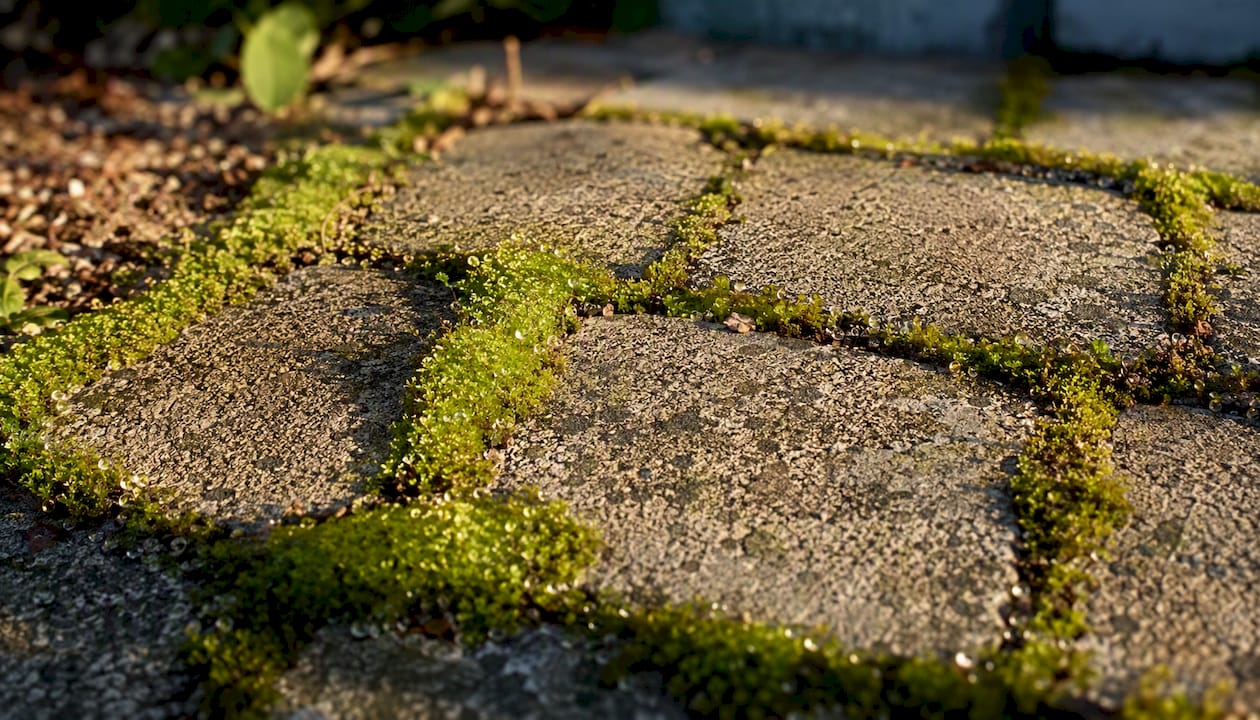
Moss between pavers is manageable either way — you can encourage it for a natural aesthetic or remove it for safety — but if it keeps coming back after cleaning, the joints and drainage need attention, not just the surface. If you’re in Raleigh, Cary, Apex, Garner, or anywhere in Wake County, TrueSeal’s paver cleaning and sealing services give you a free quote and a lasting fix.
Three paths, one decision:
Grow it: Shade, moisture, and clean joints are all you need to get moss established reasonably quickly.
Remove it: Manual scraping, boiling water, or a commercial biocide clears moss fast — but joints need refilling afterward.
Prevent it: Polymeric sand and a quality sealer are the two most reliable ways to stop moss and weeds from returning.
Pro Tip: If you see green algae on your patio or black algae on concrete alongside the moss, those are separate organisms but share the same root cause: shade and trapped moisture. Fixing the conditions addresses all three at once.
Key Takeaways
Moss between pavers always signals a site condition — shade, moisture, or open joints — and removing it without fixing those conditions means it returns within one season.
Point | Details |
Grow vs. remove decision | Base the choice on traffic level, slip risk, and joint condition — not just appearance. |
Fastest removal options | Boiling water and white vinegar kill moss on contact but require repeat treatments and follow-up re-sanding. |
Polymeric sand prevents return | Bonded joints resist moss, weeds, and ants far better than regular jointing sand when installed correctly. |
Fix the site, not just the surface | Correcting drainage, trimming shade, and refilling joints are what stop moss from re-establishing. |
TrueSeal for full restoration | TrueSeal handles cleaning, polymeric sand replacement, compaction, and sealing across Wake County with a free remote quote. |
Table of Contents
Should you encourage moss or remove it from your pavers?
The right call depends on how you use the space and what condition the joints are in.
Choose to encourage moss if:
The path is decorative and sees little foot traffic.
The area is naturally shaded and stays damp (north-facing beds, under tree canopy).
Joint sand is intact and the pavers are level and stable.
You want a low-maintenance, naturalistic look and accept some seasonal slipperiness.
Choose to remove moss if:
The surface is a main walkway, driveway, or pool deck where slip risk matters.
Pavers are shifting or joint sand has washed out.
You’re seeing pooling water, which means drainage is already compromised.
Black algae on concrete or green algae on the patio is spreading alongside the moss.
Moss itself won’t crack pavers, but it holds moisture against the surface and can accelerate freeze-thaw damage in colder winters. A decorative garden path with established moss is a reasonable choice. A mossy front walkway in Cary or Apex where guests walk after rain is a liability.
Pro Tip: Rub the surface with your shoe on a damp morning. If it slides, that’s your answer — remove the moss and seal the surface before someone gets hurt.
How to grow moss between pavers intentionally
Getting moss established in paver joints takes patience and the right conditions, but the process itself is straightforward.
Site preparation
Clear all existing weeds, debris, and loose soil from the joints. Weeds growing between pavers compete with moss and usually win.
Check joint depth. Moss needs a shallow, stable base — joints packed too deep with loose soil invite weeds instead.
Confirm drainage is adequate. Moss needs moisture, not standing water. If water pools for hours after rain, address the grade before planting.
Lightly roughen the joint surface with a stiff brush so the moss has something to grip.
Choosing the right moss
Light exposure determines which moss type will survive:
Sheet moss (Hypnum spp.): Best for full shade to partial shade. Dense, carpet-like, and the easiest to establish in joints.
Sun-tolerant cushion moss (Leucobryum spp.): Handles up to 4 hours of direct sun. More forgiving in partly open areas.
Source moss from a reputable nursery or choose paving materials and plant companions that suit your microclimate. Harvesting moss from the wild is restricted in many states — buy it or propagate from a small purchased clump.
Planting and establishment
Transplant method: Press small pieces of moss firmly into damp joints. Pack them in so they make full contact with the joint base.
Slurry method: Blend moss with buttermilk (roughly equal parts) into a thick paste and paint it into the joints with a brush. Buttermilk lowers pH slightly and helps moss adhere.
Water the joints daily for the first two weeks, then every two to three days through weeks three and four. Established moss is drought-tolerant, but the first 4–8 weeks are critical. Expect visible coverage within several weeks under good shade and moisture conditions; full, dense growth typically takes one full growing season.
One caution: avoid packing excess soil into joints during planting. Soil invites weeds growing between pavers and can undermine the joint stability you need for the pavers to stay level.
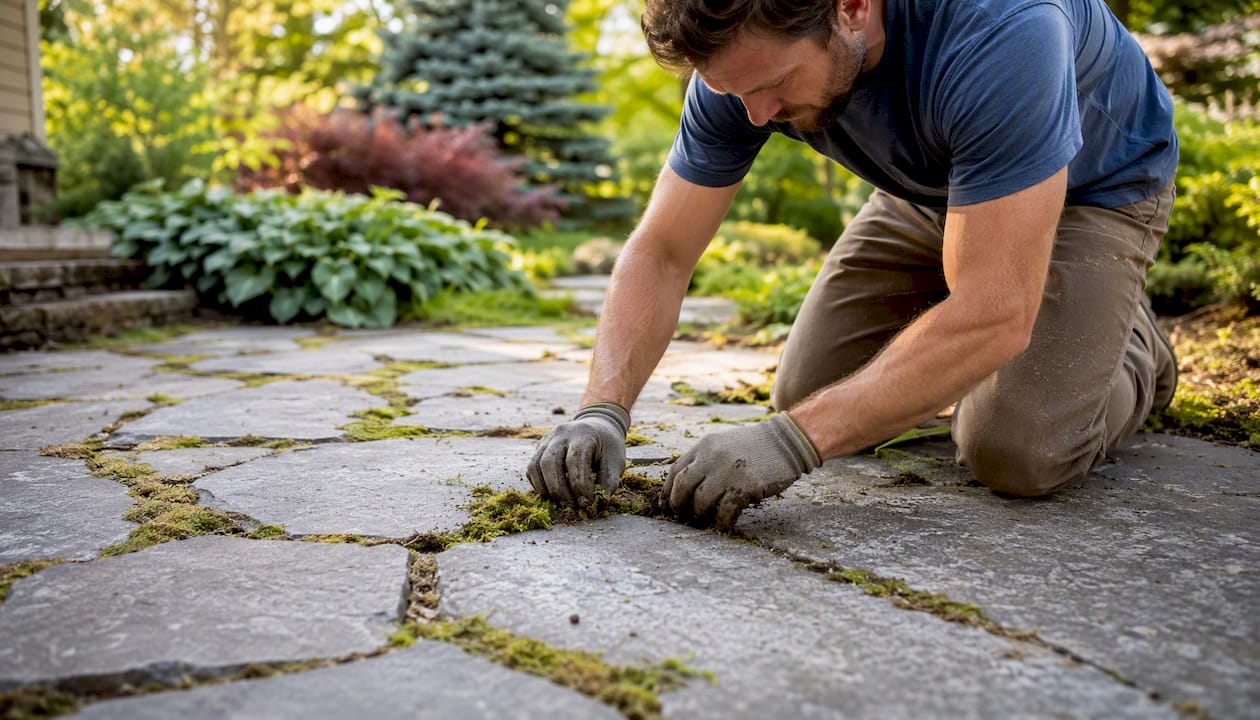
How to remove moss from pavers: methods compared
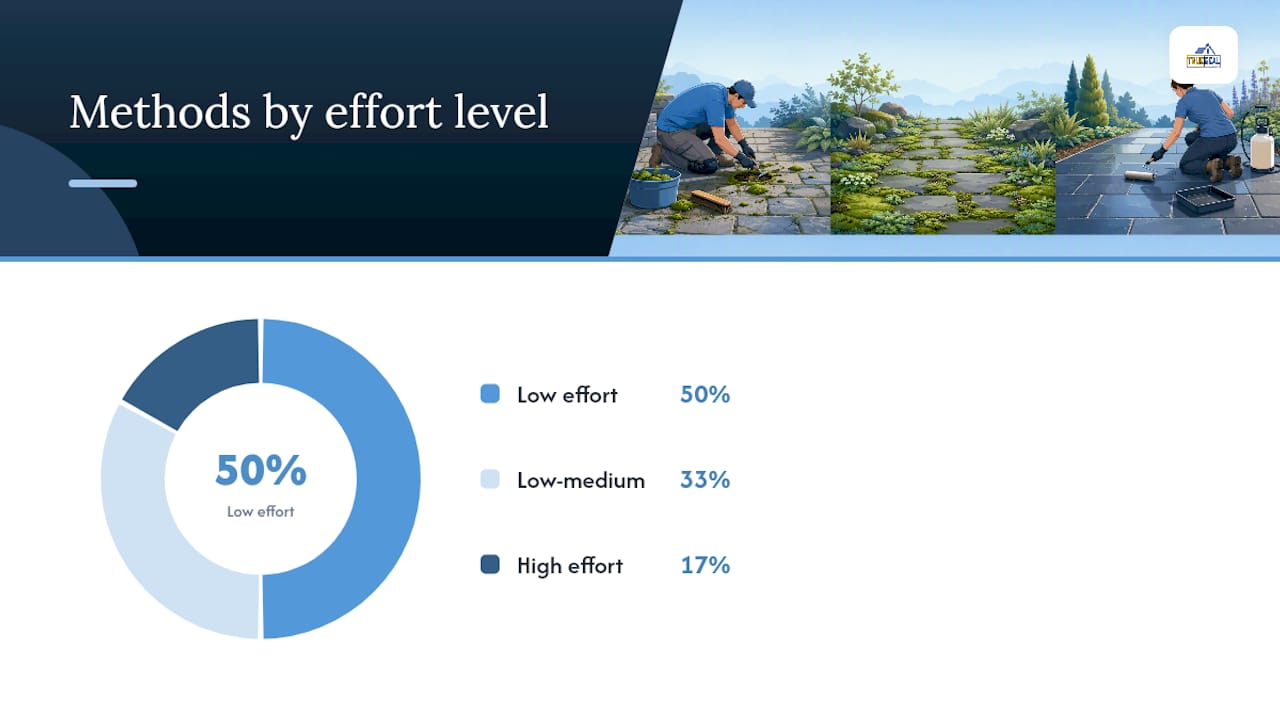
Method | Effort | Effect on joints | Best for |
Manual scraping/stiff brush | Low-medium | Minimal if done carefully | Small patches, delicate pavers |
Boiling water | Low | Can loosen joint sand | Small areas, no chemicals preferred |
White vinegar (5%) | Low | Minimal | Light moss, test first |
Baking soda | Low | Minimal | Light surface growth |
Commercial moss biocide | Low-medium | None if applied correctly | Larger areas, persistent moss |
Pressure washing | High | Significant — blasts out sand | Large areas, follow with re-sanding |
Boiling water kills moss cells on contact, and white vinegar dehydrates moss effectively — but both usually require repeat applications, and neither stabilizes the joints afterward. Always test vinegar on a hidden area first; it can lighten certain natural stone pavers.
Pressure washing removes moss and grime quickly, but it commonly blasts out joint sand in the process. Professionals recommend killing moss chemically first, then pressure washing at a controlled angle, and re-sanding immediately after to restore joint stability. Skipping the re-sand step is the most common reason moss returns within a season.
Safety notes:
Keep commercial biocides away from garden beds and storm drains. Read the label for dilution rates and dwell time.
Wear gloves and eye protection when using boiling water or chemical treatments.
Pressure washing at too high a PSI can etch softer pavers like sandstone or tumbled brick.
Pro Tip: Kill moss first, then pressure wash. Washing live moss just spreads spores across the surface and gives them new places to settle.
How to stop moss from coming back long-term
Cleaning removes what’s visible. Preventing recurrence means changing the conditions that made moss comfortable in the first place.
Polymeric sand vs. regular jointing sand
Polymeric sand forms bonded joints when properly activated and significantly reduces moss, weed, and ant establishment compared with regular sand. Regular jointing sand erodes with rain and foot traffic, leaving open joints that collect organic debris — exactly what moss spores need.
Selecting the right polymeric sand formulation matters: joint width, slope, and whether the base is pervious or non-pervious all affect which product performs correctly. A narrow joint (under 3/8 inch) needs a fine-grade product; wider joints need a coarser blend.
Installation non-negotiables
Per manufacturer installation guidance and Techniseal’s technical documentation:
Apply only to completely dry pavers.
Sweep sand into joints, compact with a plate compactor, then sweep again to fill any voids.
Remove all surface dust before misting — residual dust causes haze.
Mist in multiple light passes rather than one heavy soak.
Allow full cure time before foot traffic (typically 24 hours, longer in humidity).
Maintenance schedule
Task | Frequency |
Sweep debris from joints | Monthly or after heavy leaf fall |
Inspect joint fill level | Annually, before spring |
Re-sand low or eroded joints | Every 3–5 years, or as needed |
Re-seal pavers | Every 2–3 years depending on traffic and exposure |
Site fixes that reduce moss pressure
Trim overhanging branches to increase sunlight on shaded paver areas.
Clear gutters and downspout extensions so water doesn’t sheet across paved surfaces.
Correct the grade if water pools near the paver field — a 1–2% slope away from structures is the standard target.
Clean organic debris (leaves, pine needles) regularly; decomposing matter feeds moss and fills joints.
For a deeper look at patio sealing options and timing, the right sealer type makes a measurable difference in how long prevention holds.
When should you call a professional for paver moss problems?
DIY methods work well for small patches and light growth. Call a contractor when:
Moss returns within one season after cleaning.
Joint sand has washed out across a significant portion of the surface.
Pavers are shifting, rocking, or showing uneven settlement.
Water pools on or near the paver field after normal rain.
The affected area is large enough that pressure washing and re-sanding would take a full weekend or more.
What to ask a contractor before hiring
What polymeric sand product do you use, and is it matched to my joint width and base type?
Do you kill moss before pressure washing, or wash first?
What PSI and tip angle do you use on pavers?
Do you compact after re-sanding, and how many passes?
What sealer do you apply, and what’s the expected recoat interval?
Can you show before/after photos of similar projects?
TrueSeal handles the full sequence for homeowners across Wake County: paver cleaning, polymeric sand replacement, compaction, and sealing, with a remote assessment process that lets you get a tailored quote without scheduling an on-site visit first. The service area covers Raleigh, Cary, Apex, and Garner.
For a full walkthrough of what professional restoration involves, the restore faded pavers guide covers the step-by-step workflow from cleaning through sealing.
Why moss keeps coming back unless you fix the conditions
Moss spreads by spores, which are airborne and land on virtually every outdoor surface. A clean paver won’t stay moss-free for long if the microclimate still offers shade, moisture, and open joints packed with organic material. The RHS confirms that moss on hard surfaces is a reliable indicator of drainage or shade issues, and that it will return unless those underlying conditions are corrected alongside cleaning.
The three-part method that actually holds:
Remove existing moss completely (don’t just suppress it).
Refill and stabilize joints with polymeric sand.
Correct the moisture or shade condition driving growth.
Moss is not a surface problem — it’s a site condition problem. Cleaning the surface without addressing drainage, shade, or joint stability is a short-term fix. The spores are always present; what changes is whether your pavers give them a place to take hold.
TrueSeal’s perspective on moss between pavers
Moss on a shaded garden path in a Cary backyard? That can be a deliberate, attractive choice — and we’ve seen it done well. The problem is when that same low-traffic aesthetic creeps onto a front walkway or a pool deck in Apex, where wet moss on a smooth paver surface becomes a real safety concern.
What we see most often in Wake County is moss that started small and went unaddressed until joint sand was gone and pavers had begun to shift. At that point, a simple cleaning isn’t enough. The joints need extraction, re-sanding with the right polymeric product, compaction, and sealing — otherwise the moss is back before the next rainy season.
If you’re unsure whether your situation calls for a quick DIY fix or a full restoration, send us photos. TrueSeal’s remote assessment process is built for exactly that: a real evaluation without requiring you to schedule a visit first.
TrueSeal cleans, re-sands, and seals pavers across Wake County
Moss, algae, and eroded joints are problems TrueSeal resolves in a single service visit for homeowners across Raleigh, Cary, Apex, Garner, and Wake County. The process covers inspection and moss treatment, joint extraction, polymeric sand replacement with the correct formulation for your joint width and base, plate compaction, and a professional-grade sealer that protects against moisture, UV, and future organic growth.
[
TrueSeal’s remote assessment means you can get a tailored quote by sending photos — no waiting for a site visit to find out what the job involves or what it costs. Residential paver services start with a free quote, and the work comes with a durable finish designed to last, not just look good on day one. Request your free quote at Truesealcoating.
Sources
FAQ
Does vinegar kill moss between pavers permanently?
Repeat applications are usually needed, and without joint stabilization, moss returns.
Will boiling water kill moss between pavers?
Yes — boiling water kills moss cells on contact and is one of the safest chemical-free options. It works best on small areas and still requires follow-up re-sanding to close the joints moss was growing in.
Does vinegar mixed with dish soap kill moss more effectively?
Adding dish soap (such as Dawn) helps the vinegar solution cling to the moss surface longer, which can improve contact time. The combination is more effective than vinegar alone on thicker growth, but repeat treatments and joint refilling are still needed for lasting results.
What kills moss permanently between pavers?
No single treatment kills moss permanently. Long-term control requires removing existing moss, refilling joints with polymeric sand, sealing the surface, and correcting the shade or drainage conditions that allowed moss to establish. That three-part approach is what TrueSeal’s paver restoration service delivers.


Comments