Rain After Sealcoating in North Carolina: What Every Homeowner Must Know

Updated: Aug 12
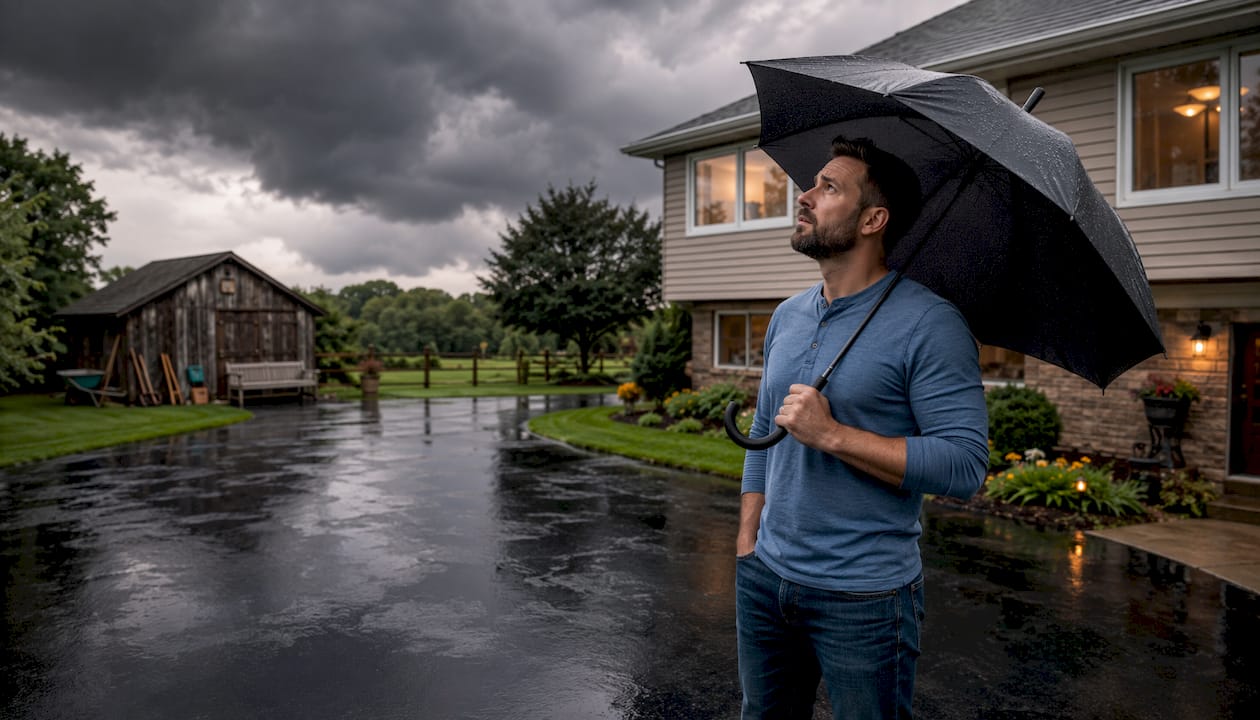
Rain on a freshly sealcoated driveway is one of the most common — and costly — mistakes in pavement maintenance. If rain falls before the sealant has properly dried and cured, it can wash away unset material, leave streaks across the surface, and force a complete reapplication. The critical window is a couple of days of rain-free weather after application. Miss that window, and you’re looking at peeling, blotchy color, and a driveway that’s less protected than before you started.
Common damage types from premature rain exposure include:
Washout: Rain physically removes unset sealant, leaving bare patches.
Streaking: Water mixing with wet sealer creates visible lines and discoloration.
Peeling and flaking: Sealant that partially cured before rain lifts away from the surface.
Uneven texture: Thin spots and pooling areas develop where sealant washed thin.
Pro Tip: Before scheduling any sealcoating project, check a 72-hour forecast, not just the day-of weather. North Carolina’s afternoon thunderstorms can appear with little warning, especially from May through September.
Need professional sealcoating in Cary, Apex, or Raleigh? Explore TrueSeal’s residential sealing services before your next project.
Table of Contents
What actually happens when rain hits too soon after sealcoating
TrueSeal’s expert approach to sealcoating and weather protection
Why sealcoating is worth it, even with rain risks factored in
What weather conditions give sealcoating the best chance to last
How to repair a sealcoated surface that rain has already damaged
TrueSeal protects your driveway before the rain has a chance to
How drying time and cure time differ for sealcoating
These two terms get used interchangeably, but they describe completely different stages — and confusing them is exactly how rain damage happens.
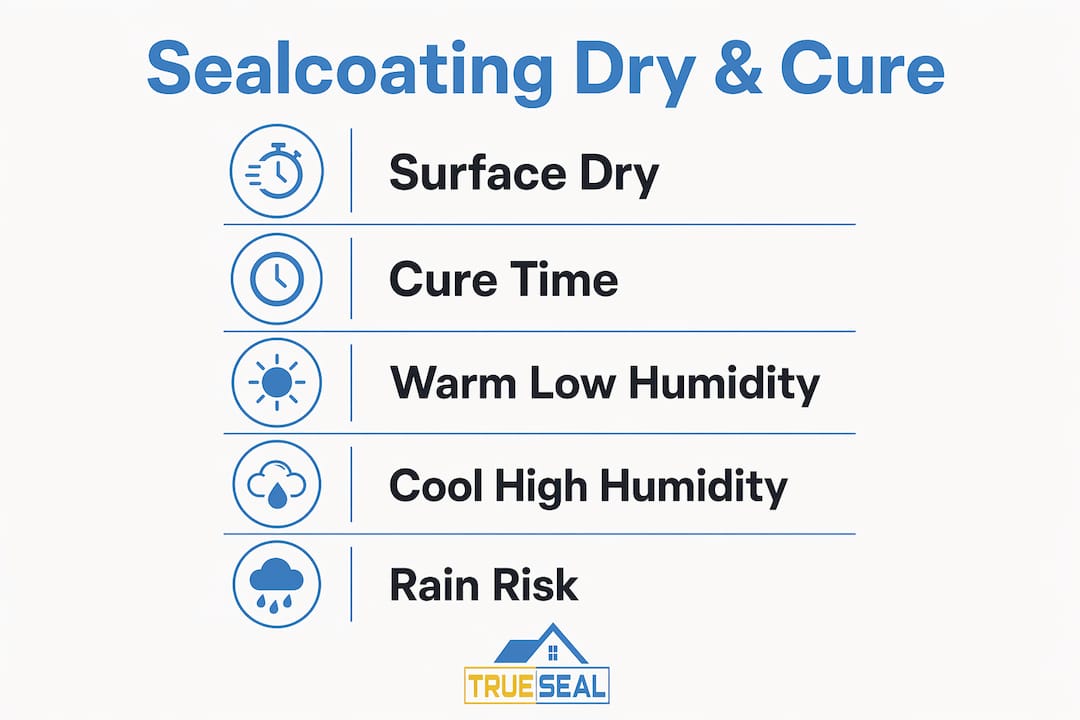
Drying is the evaporation phase. Surface solvents and water escape into the air, and the pavement feels dry to the touch within 4–8 hours under typical warm conditions. That “dry to the touch” feeling is misleading. The sealant is still chemically soft underneath and highly vulnerable to water infiltration.
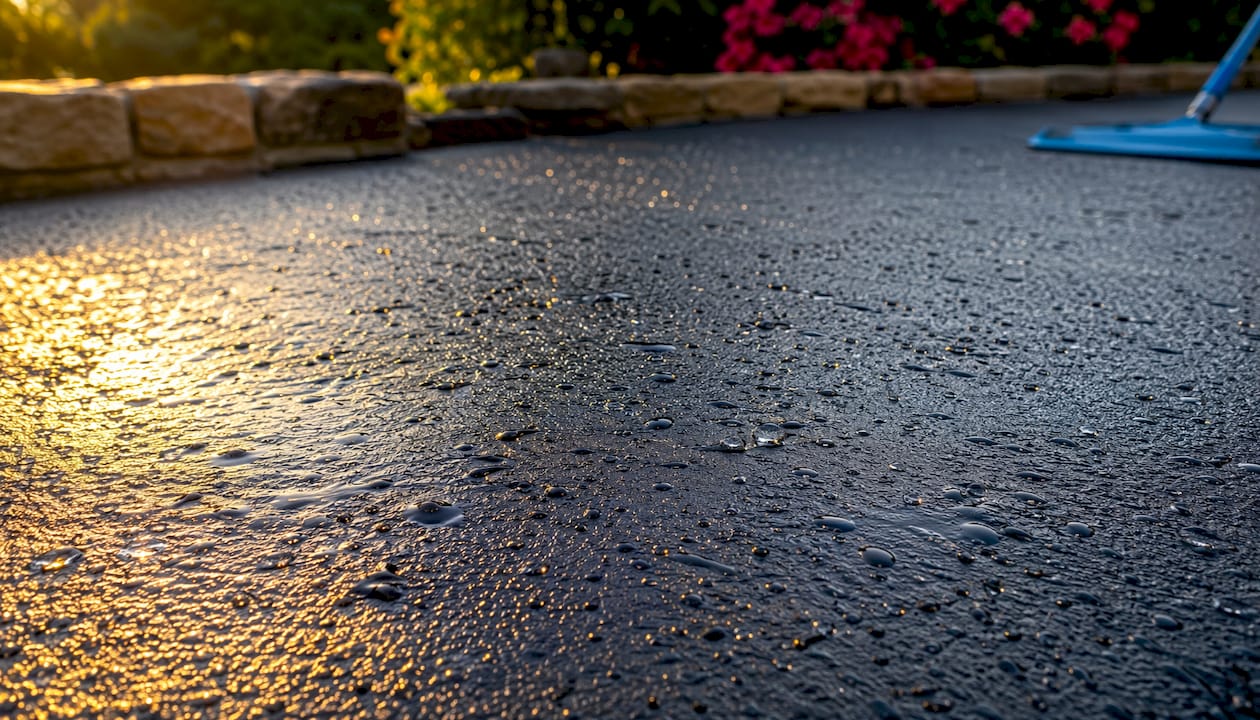
Curing is the chemical hardening phase, where the binder fully bonds to the asphalt surface. Full cure can take about a day or two, and in humid or cool conditions, it can stretch longer. Until curing completes, even a moderate rain event can soften the film and cause lasting damage.
Three weather factors directly control both timelines:
Temperature: Warmer pavement speeds evaporation. Below 50°F, drying slows significantly and curing may stall.
Humidity: High humidity traps moisture near the surface, delaying evaporation and extending both phases.
Dew point: If pavement temperature drops close to the dew point overnight, condensation can form on a partially cured surface and cause adhesion defects.
Condition | Surface Dry Time | Full Cure Time |
Warm, low humidity | several hours | about a day |
Moderate temperature and humidity | longer hours | one to two days |
Cooler, high humidity | longer drying and curing times | |
Overcast, high humidity | extended drying and curing period |
The takeaway: a driveway that feels dry after six hours is nowhere near ready for rain. Plan for the full cure window, not just the surface-dry phase.
What actually happens when rain hits too soon after sealcoating
Rain within 12 hours of application is the highest-risk scenario. At that stage, the sealant binder is still soluble, and water essentially dissolves and displaces it. The result is rarely subtle.
Visible signs of rain damage on sealcoated surfaces include:
Peeling or flaking sections where the sealant lifted
White or gray streaks running in the direction of water flow
Blotchy, uneven color across the surface
Pooling water in areas where sealant washed thin
Chalky residue left behind as the binder dried unevenly
Rain between 12 and 24 hours post-application is less catastrophic but still damaging. The surface film may hold in places while washing away in others, creating an inconsistent protective layer. Heavy rain within 24 hours can soften even a partially cured film enough to cause long-term adhesion problems.
The long-term consequences extend beyond appearance. Thin or missing sealant coverage allows UV oxidation and water infiltration to accelerate, which leads to cracking and surface degradation years sooner than a properly cured application would. Do not attempt repairs on a surface that is still soft or damp — that traps moisture and causes blistering.
How to protect a freshly sealcoated driveway from rain
Prevention is the only reliable strategy here. Once rain hits an uncured surface, your options shrink fast.
Schedule around a confirmed 48-hour dry window. Check forecasts from multiple sources the day before and morning of application. If there’s any doubt, reschedule.
Monitor dew point, not just temperature. Pavement temperature should stay at least 5°F above the dew point for a minimum of 8 hours after application to prevent condensation-related adhesion failure.
Avoid sealcoating late in the afternoon. In North Carolina, afternoon humidity rises and temperatures drop after sunset. Morning applications give the surface maximum drying time before overnight conditions change.
Use tarps for light drizzle only. Tarps can offer limited protection from light drizzle but are not effective against heavy rain. They are a last resort, not a plan.
Divert water flow away from the driveway. If rain is unavoidable, redirect downspouts and surface drainage away from the freshly sealed area to reduce direct water contact.
Keep all traffic off the surface. Foot traffic during the first 24 hours and vehicle traffic during the first 48 hours both compromise curing, even in dry conditions.
Pro Tip: Pavement temperature must stay at least 5°F above the dew point for 8 hours post-application. Use a weather app that shows hourly dew point data, not just humidity percentage, to verify overnight conditions before you commit to a morning application.
Avoid sealcoating if rain is forecast within 48 hours
Target application temperatures between 50°F and 85°F
Aim for humidity below 80% during and after application
Keep the surface free of foot and vehicle traffic for at least 24–48 hours
TrueSeal’s expert approach to sealcoating and weather protection
TrueSeal’s Clean & 7-Year Seal system was built specifically for North Carolina’s climate, where summer humidity, afternoon storms, and variable spring temperatures create real scheduling challenges. Getting the timing right is as important as the product itself.
TrueSeal technicians assess pavement temperature, ambient humidity, and dew point before every application. No job starts if conditions don’t meet the standards for a full cure window. That discipline protects both the surface and the investment the property owner is making.
What TrueSeal brings to every project:
Pre-application weather analysis covering temperature, humidity, and dew point
Premium-grade sealant materials formulated for durability in humid southeastern conditions
Precise application equipment that minimizes overspray and ensures even coverage
Scheduling flexibility to reschedule around weather without penalty
Long-term preservation focus for both residential driveways and commercial parking lots
Why sealcoating is worth it, even with rain risks factored in
Properly cured sealcoating is a cost-effective form of pavement maintenance. The risks from rain are real but entirely manageable with correct scheduling. The benefits of a well-applied, fully cured sealcoat far outweigh the inconvenience of waiting for the right weather window.
Key benefits of properly applied asphalt driveway sealer:
UV oxidation protection: Sealcoating blocks the sun’s rays that cause asphalt to dry out, crack, and turn gray.
Water infiltration reduction: A cured sealcoat prevents water from penetrating the asphalt base, which is the primary cause of pothole formation.
Improved appearance: Fresh sealcoating restores a clean, uniform black finish that significantly improves curb appeal.
Extended pavement life: Regular sealing, combined with proper surface preparation, can meaningfully extend the useful life of an asphalt surface.
Lower long-term costs: Preventive sealing costs a fraction of crack repair or full resurfacing.
Sealcoating is not a one-time fix. Asphalt surfaces in North Carolina’s climate benefit from resealing every one to two years to maintain consistent protection against oxidation and moisture. Early detection of wear, thin spots, or peeling makes touch-up work straightforward and inexpensive.
What weather conditions give sealcoating the best chance to last
The ideal sealcoating window is dry, warm weather with temperatures between 50°F and 85°F and humidity below 80%. In North Carolina, that points to late spring (April through May) and early fall (September through October) as the most reliable seasons. Summer works well in terms of temperature, but afternoon storm activity in the Triangle area requires careful morning scheduling.
Conditions to avoid:
Rain forecast within 48 hours of planned application
Overnight temperatures expected to drop below 50°F within the cure window
High humidity days above 80%, which slow evaporation and extend cure time
Direct application on wet or damp pavement surfaces
Morning applications on clear, low-humidity days give the sealant the longest possible drying window before overnight temperatures and dew point converge. Checking an hourly forecast, not just a daily summary, is the difference between a successful project and a costly redo.
How to repair a sealcoated surface that rain has already damaged
If rain hit your driveway before the sealant cured, patience is the first step. Attempting repairs on a surface that is still soft or damp traps moisture and leads to blistering, peeling, and long-term failure. Wait a full 24–48 hours for the surface to dry completely before assessing the damage.
Step-by-step repair process:
Wait for full drying. Give the damaged surface at least 24–48 hours of dry weather before touching it.
Inspect the damage. Look for peeling, discoloration, blotchy texture, water pooling, and chalky residue to determine how much sealant was lost.
Clean the surface. Remove any loose or flaking sealant material. A pressure wash followed by complete drying is the standard prep step.
Reapply sealant. For significant washout, a full recoat is more reliable than spot patching. Spot repairs often leave visible seams.
Confirm weather before reapplication. The same 48-hour dry window applies to the repair coat. Don’t rush back into the same situation.
Minor streaking from a brief light drizzle may fade as the sealant finishes curing. Significant washout, peeling, or bare patches require professional reapplication to restore consistent protection.
TrueSeal protects your driveway before the rain has a chance to
North Carolina homeowners and property managers don’t have to gamble on the weather. TrueSeal’s Clean & 7-Year Seal system is designed for exactly this climate, with scheduling built around confirmed dry windows and application standards that account for temperature, humidity, and dew point before a single drop of sealant goes down.
[
If your driveway, parking lot, or hardscape surface needs professional sealing, TrueSeal handles the weather planning, the surface preparation, and the application with the precision that prevents costly redos. Serving Cary, Apex, Raleigh, Morrisville, and greater Wake County, TrueSeal is the long-term preservation partner for surfaces that need to last.
Schedule your free surface assessment today. Visit TrueSeal’s residential services page or contact us directly to get a quote for your driveway, patio, or commercial pavement.
Key Takeaways
Fresh sealcoating requires a full 24–48 hour rain-free window to cure properly; rain before that window closes can wash away sealant, cause peeling and streaking, and require complete reapplication.
Point | Details |
Rain-free window required | Sealcoating needs 24–48 hours without rain to cure; exposure before that causes washout and streaking. |
Dry time vs. cure time | Surface feels dry in 4–8 hours, but full chemical hardening takes 24–48 hours or longer in humid conditions. |
Dew point matters | Pavement temperature must stay at least 5°F above the dew point for 8 hours post-application to prevent adhesion failure. |
Repair requires patience | Wait 24–48 hours after rain damage before reapplying; recoating a damp surface traps moisture and causes blistering. |
TrueSeal’s approach | TrueSeal schedules around confirmed dry windows and assesses dew point and humidity before every application in Wake County. |
FAQ
What if it rains after sealcoating?
If rain falls within the first 24–48 hours, it can wash away unset sealant, causing streaks, thin spots, and bare patches. Wait for the surface to dry completely before assessing damage and scheduling a reapplication.
How long does sealer need to dry before rain?
Sealcoating needs at least 24–48 hours of rain-free weather to cure properly. Surface drying takes 4–8 hours, but the sealant remains chemically vulnerable until full cure is complete.
How long before a newly sealed driveway can get wet?
Allow at least 24–48 hours before any moisture exposure for reliable protection. In cool or humid conditions, it may be worth extending that window to reduce the risk of adhesion problems.
How long does asphalt need to dry before it rains?
Freshly sealcoated asphalt needs a 24–48 hour dry window for proper curing. The first 4–8 hours are the highest-risk period; rain during that phase can wash away up to 40% of the unset sealant.
Recommended
Comments