Seal Before Winter: Cut Driveway Salt Damage 70–80% for Homeowners

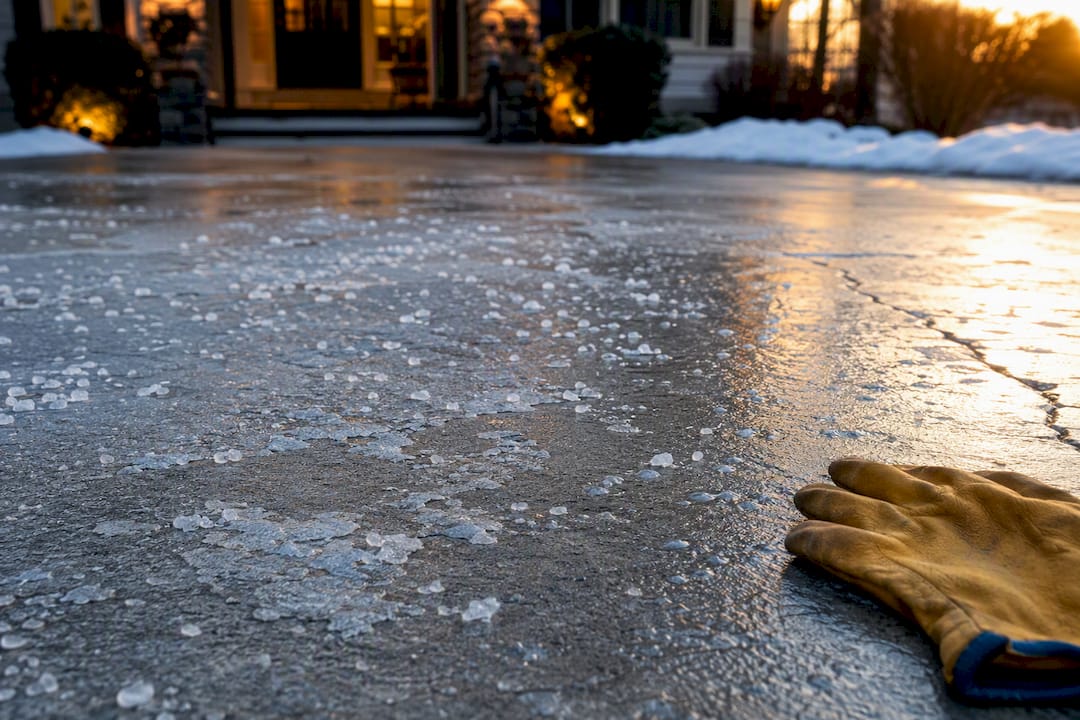
Yes, salt damages driveways, and it happens in two ways at once: it forces concrete or asphalt through more freeze-thaw cycles each winter, and in concrete, chlorides trigger a chemical reaction that breaks down the paste from the inside. One heavy application after a surprise ice storm won’t ruin your driveway, but repeated exposure without protection leads to scaling, spalling, and cracked edges. The fix is straightforward: shovel snow promptly, skip rock salt on unsealed concrete, choose a gentler de-icer, and seal the surface before winter arrives.
TL;DR:
Repeated salt exposure destroys driveway surfaces through freeze-thaw cycles and chemical reactions, leading to scaling, spalling, and potential structural damage.
Proper sealing with penetrating water-repellent sealers before winter can prevent 70 to 80 percent of salt-related deterioration.
Early signs of damage include surface scaling, deeper spalling, white efflorescence, and rust stains, with deeper cracks indicating serious issues.
Maintaining good drainage, removing snow promptly, and avoiding salt on fresh concrete significantly extend driveway lifespan.
Regular spring rinsing and resealing are essential to remove residual salts and prevent long-term structural and safety hazards.
Table of Contents
How Salt Damage to Driveways Actually Happens
Salt doesn’t eat through concrete or asphalt directly. It works by manipulating water, and water is what does the damage.
Rock salt lowers the freezing point of water on your driveway’s surface. That sounds helpful, since it melts ice, but it also means the water on your slab thaws and refreezes far more often than it would naturally. Each freeze cycle expands the water trapped in the pores of the concrete by about 9%, and that expansion pushes outward against the surrounding material. Do that dozens of times in a season and the surface starts flaking away, a process called scaling.
Concrete faces a second threat that asphalt doesn’t. At moderate cold temperatures, chloride ions from de-icing salt can react with compounds in the concrete to form calcium oxychloride, a mineral that takes up more space than what it replaced. The CP Tech Center’s technical brief on deicing salts identifies this reaction as a distinct mechanism from ordinary freeze-thaw stress, and it’s why chloride exposure often does more harm to concrete than plain water ever would.
Asphalt handles salt differently. There’s no equivalent chemical reaction, but salty brine still seeps into surface cracks, and repeated freeze-thaw and wet-dry cycling weakens the bond between asphalt and the aggregate underneath it, according to research on salt’s effects on pavement durability. The result is the same story with a different plot: faster cracking, then potholes.
Salt lowers the freezing point, increasing freeze-thaw cycles on both surfaces
Concrete: chloride reactions form calcium oxychloride, expanding internally
Asphalt: brine penetrates cracks and weakens the aggregate bond
New concrete needs roughly 28 days to cure before facing de-icers or sealer
New concrete is especially vulnerable. Manufacturer guidance recommends waiting about 28 days before exposing a fresh slab to de-icing salt, and full strength takes even longer. If you poured a new driveway this year, treat it gently through its first winter.
Spotting Salt Damage Before It Spreads
Salt damage rarely appears overnight. It shows up in stages, and catching it early is the difference between a patch job and a full section replacement.
Look for these signs during your regular walk-rounds:
Scaling: a thin, flaky layer peeling off the surface, often the first visible sign
Spalling: deeper chunks or pits where whole pieces of concrete have broken away
Efflorescence: a white, powdery residue that signals salt and moisture moving through the slab
Rust staining: orange or brown streaks that mean water and chloride have reached the steel reinforcement underneath
Depth tells you how serious the problem is. Damage under 1/8 inch is largely cosmetic. Anything deeper than 1/2 inch, especially with exposed rebar or crumbling edges, points to a structural issue that needs a professional look.
Pro Tip: Pour a few drops of water on your driveway. If it beads up and sits on the surface, your sealer is still working. If it soaks in within a minute, that’s your cue to reseal before the next freeze.
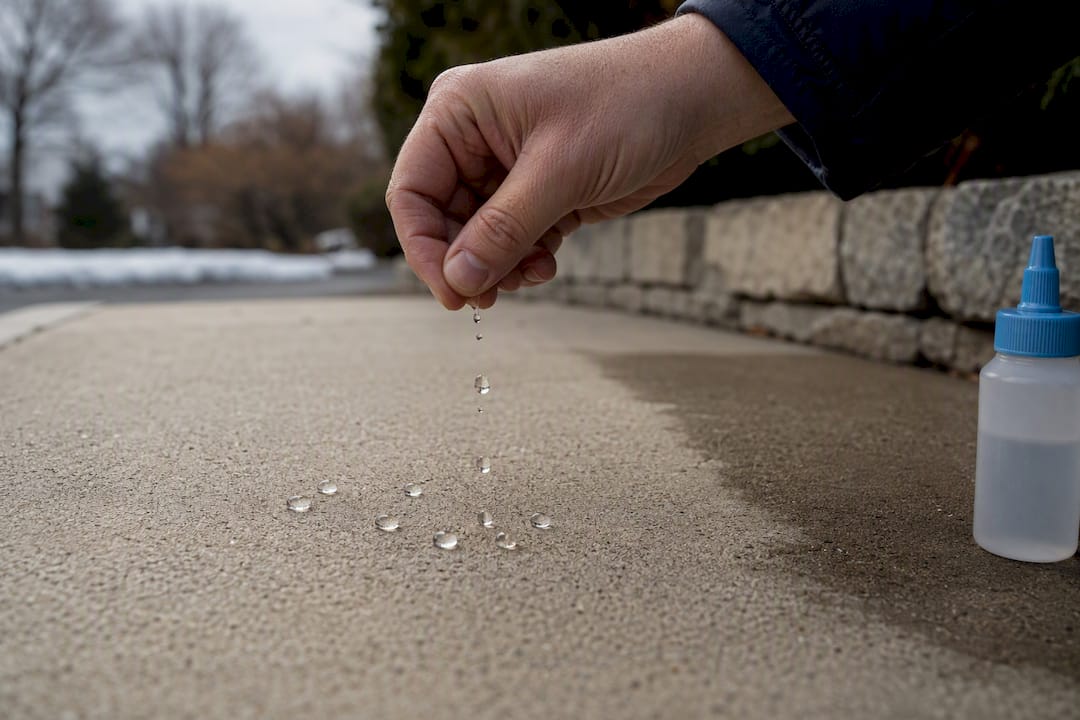
Make this check part of your monthly winter routine. New cracks or crumbling edges are far cheaper to address in January than in March.
A Winter Prevention Plan That Actually Works
Prevention beats repair on cost, effort, and peace of mind every time. Here’s the order that matters:
Seal before the first freeze. Penetrating silane/siloxane sealers soak into the concrete’s pores and repel water instead of just coating the surface, which is exactly what you want against chloride intrusion. Apply in late summer or early fall, when temperatures allow proper curing before the first freeze.
Remove snow mechanically, first. Shovel or plow before ice bonds to the surface. A plastic-bladed shovel avoids scratching a sealed surface, and getting snow off early reduces how much de-icer you need at all.
Choose your de-icer carefully. Calcium chloride and magnesium chloride cause less damage than plain rock salt (sodium chloride), and CMA (calcium magnesium acetate) is gentler still, though pricier. Skip ammonium-based fertilizers entirely; they’re among the most corrosive things you can put on concrete.
Fix your drainage. A slope of 2 to 3% keeps meltwater moving off the slab instead of pooling and refreezing overnight. Redirect roof downspouts away from the driveway, and never pile shoveled snow where it will melt back onto the surface.
Respect new concrete. If your driveway was poured this year, hold off on both de-icers and sealer until it’s properly cured.
Sealing carries the biggest single payoff. According to the Portland Cement Association, applying a penetrating sealer before winter prevents 70 to 80% of salt-related damage. That’s not a marginal improvement, it’s the difference between a driveway that looks the same in ten years and one that’s flaking apart in three.
Pro Tip: Apply de-icer sparingly and follow the bag’s rate guidance. More salt doesn’t melt ice faster, it just adds more chloride sitting on your surface longer.
Repairing Salt Damage: What Fits Your Situation
The right repair depends entirely on how deep the damage goes, and guessing wrong wastes both time and money.
Shallow scaling (under 1/8 inch): Clean the area, apply a bonding agent, then a cementitious patch, and reseal immediately. This is a weekend-scale fix for cosmetic flaking.
Moderate spalling (roughly 6 to 12 mm, borderline territory): Remove the loose material, treat any exposed rebar to stop corrosion, then decide between partial-depth patching and a full resurfacer based on how well the surrounding concrete still bonds.
Severe damage: Deep pits, heaving sections, or widespread rebar exposure usually mean partial or full replacement. This calls for a structural assessment, not a patch kit.
Whatever the repair, the last step is non-negotiable: neutralize residual salts and apply a fresh penetrating sealer right away. Skipping that step means you’ve repaired the symptom and left the cause in place.
If you’re unsure which category you’re in, concrete versus asphalt care differs enough that the right diagnosis matters before you buy a patch kit.
How TrueSeal Approaches Salt Protection Differently
Most driveway advice stops at “seal it and hope.” TrueSeal starts with a digital assessment of your property, looking specifically at salt exposure risk, drainage patterns, and whether your driveway needs a straightforward seal, a resurfacing pass, or something more involved. That remote evaluation means you get a protection plan built around your actual slab, not a generic recommendation.
Surface prep is where most driveway sealing shortcuts happen, and it’s also where TrueSeal spends the most attention. Before any penetrating silane/siloxane finish goes down, the surface has to be cleaned and any residual chlorides neutralized. Sealing over salt that’s still sitting in the pores locks in the problem rather than solving it.
A driveway with widespread spalling or exposed rebar isn’t a DIY weekend anymore. That’s the point where a documented, professional protection plan replaces guesswork.
Homeowners who’ve already seen spalling spread, or who simply want a durable, water-repellent finish they don’t have to think about again for years, are the ones who benefit most from bringing in TrueSeal’s commercial and residential expertise.
Remote assessment identifies risk before any work begins
Surface prep removes and neutralizes salt residue, not just dirt
Penetrating finishes repel water instead of sitting on top of it
Documented process reduces the odds of the same damage recurring
Your Spring Driveway Reset
Winter leaves salt behind, and that residue keeps working against your driveway long after the last snowfall.
Dry-sweep first. Loose salt crystals sitting on the surface should be swept away before you introduce any water, otherwise you risk driving them deeper into the pores.
Rinse from the high point down. A gentle, low-pressure rinse moves residual salt off the slab without forcing it into cracks. If you’re reaching for a pressure washer before sealing, keep the settings conservative until you know how the surface responses.
Inspect while it’s clean. Walk the whole driveway looking for new cracks, joint separation, or rust staining, and photograph anything questionable for a repair estimate.
Run the water-bead test. If water soaks into the surface within about 60 seconds instead of beading up, your sealer has worn through and it’s time to schedule a fresh coat.
A single accidental salt application from last winter’s ice storm won’t ruin your slab. It’s the repeated cycle, season after season, without a spring reset that adds up.
What Salt Damage Actually Costs You Over Time
The math on salt damage is simple, even if homeowners rarely run it until they’re facing a bill. Sealing a driveway is a modest, recurring maintenance task. Repairing scaling, spalling, or rebar corrosion is not.
A shallow cosmetic patch is manageable on its own. But once spalling reaches the point of exposed rebar or a resurfacer job, you’re paying for labor, materials, and often a wider repair area than the damage originally suggested, because deteriorated concrete tends to spread from its worst points outward. Full replacement of a driveway section costs considerably more than either option, and it comes with the added disruption of demolition and cure time before you can park on it again.
Prevention doesn’t eliminate cost, it just moves it earlier and shrinks it. A penetrating sealer applied on schedule is a small, predictable expense compared to an unplanned structural repair discovered mid-winter when a chunk of your driveway breaks loose under a tire. The 70 to 80% reduction in salt-related damage that comes with sealing isn’t just a durability number, it’s a direct predictor of how many repair calls you’ll make over the life of your driveway.
The homeowners who spend the most on driveway repair are almost always the ones who treated sealing as optional rather than routine. Think of sealing the way you think of an oil change: skip it once and nothing happens, skip it for years and you’re paying for an engine.
Building a Maintenance Habit That Actually Sticks
Salt damage is cumulative, which means the strategies that work are the ones you repeat without having to think about them.
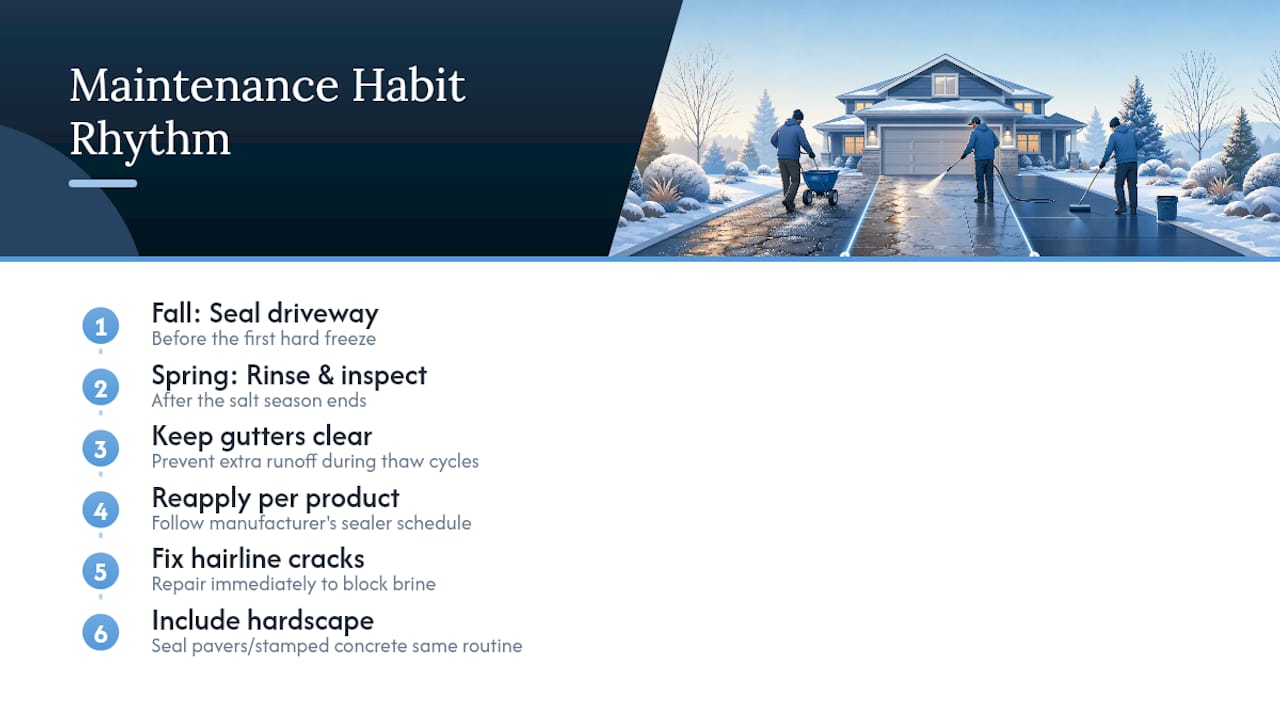
The core habit is a two-season rhythm: seal in early fall before the first hard freeze, then rinse and inspect in spring once the salt season ends. Missing either half of that cycle lets residual chloride sit in the concrete’s pores far longer than it should, quietly working on the material between the visible freeze-thaw events.
Beyond that seasonal rhythm, a few smaller habits compound over years. Keep gutters and downspouts clear so roof runoff doesn’t dump extra water onto your slab during thaw cycles. Reapply sealer on the schedule your specific product recommends rather than waiting until the water-bead test fails, since a driveway with a fully worn sealer is already absorbing chlorides by the time you notice. Address hairline cracks immediately, since a crack is where brine finds its fastest path into the material.
Decorative or stamped concrete needs the same discipline, sometimes more, since color coatings and textured surfaces can hide early scaling until it’s advanced. If your driveway includes hardscape features like pavers or stamped patterns, factor their specific sealing needs into the same fall and spring routine rather than treating them as a separate project.
None of this requires tracking software or a maintenance app. It requires two dates on a calendar, kept every year, for as long as you own the driveway.
Why Salt Damage Is a Safety Issue, Not Just a Cosmetic One
A driveway riddled with spalling and rebar exposure isn’t just unattractive, it’s a structural and safety liability that gets worse the longer it’s ignored.
Structurally, chloride-driven corrosion attacks the steel reinforcement inside concrete slabs, and rusting rebar expands as it corrodes, cracking the surrounding concrete from the inside out. That’s a feedback loop: corrosion causes cracking, cracking lets in more water and salt, and more salt accelerates further corrosion. Left unaddressed for enough winters, sections of a driveway can heave, settle unevenly, or develop voids underneath the surface that aren’t visible until the top layer collapses.
The safety concerns are more immediate. Pitted, scaled, or spalled surfaces create uneven footing that becomes a tripping hazard, especially for older family members or anyone carrying groceries in the dark. Deep potholes or crumbling edges near asphalt driveways can damage tires and undercarriages, and a slab with hidden voids underneath can shift unpredictably under the weight of a parked vehicle.
None of this happens overnight, which is exactly why regular inspection matters more than a one-time fix. Catching scaling before it becomes spalling, and spalling before it reaches rebar, keeps the problem in the cosmetic category instead of the structural one. A driveway that’s properly sealed and monitored rarely reaches the point where safety, rather than appearance, becomes the concern.
What Homeowners Get Wrong About Salt Damage
Most driveway advice treats salt damage like a materials-science problem, and that’s backwards for the average homeowner. The chemistry matters, but you don’t need to understand calcium oxychloride formation to protect your driveway. You need to seal it on schedule and rinse it in spring.
The bigger mistake is treating sealing as a one-time job instead of a recurring habit tied to the calendar. A sealer applied five years ago has almost certainly worn thin, and a driveway that “was sealed” isn’t the same as one that’s currently protected. Conventional advice tends to bury this timing detail under generic maintenance tips, when it’s actually the single biggest lever homeowners have.
The other overlooked piece is drainage. Homeowners fixate on de-icer brand choice while ignoring the 2 to 3% slope that determines whether water sits and refreezes on their slab in the first place. A gentler de-icer on a poorly draining driveway still leaves you fighting freeze-thaw cycles every night the temperature dips.
If you take one thing from this guide, make it the fall and spring rhythm: seal before the first freeze, rinse and inspect once the season ends. Everything else, de-icer choice, snow removal technique, patch versus replace, is secondary to keeping that cycle consistent year after year.
— TrueSeal
Ready to Protect Your Driveway This Winter?
Most driveway sealing gets sold as a one-time touch-up. TrueSeal treats it as a protection plan, built around your specific slab through a remote digital assessment that checks salt exposure, drainage, and surface condition before any work begins, so you’re not guessing whether a basic seal or a more involved resurfacing job is the right scope.
[
That assessment matters because a sealer applied over unprepped, salt-saturated concrete just locks the problem in. TrueSeal’s process starts with proper cleaning and salt neutralization, then applies a penetrating, water-repellent finish designed to hold up through repeated freeze-thaw seasons rather than wearing thin after one winter. If your driveway is already showing spalling, rust staining, or has never been sealed, that’s the point where a documented professional plan beats another round of DIY patching.
Explore TrueSeal’s concrete and pavement services or check the residential protection options to get a tailored plan before the next freeze sets in.
Sources
FAQ
What is the best sealer to protect a driveway from salt damage?
Penetrating silane/siloxane sealers are the recommended choice because they soak into the concrete’s pores and repel water rather than just coating the surface, which directly blocks chloride intrusion rather than masking it.
What neutralizes salt in concrete?
A dry-sweep to remove loose crystals followed by a controlled water rinse removes most surface salt; for baked-in residue, a neutralizing concrete cleaner paired with a professional pressure wash before repairs or resealing handles what plain rinsing misses.
How long does it take for salt to damage a driveway?
There’s no fixed timeline. A single heavy application rarely causes lasting harm, but repeated exposure over multiple winters without sealing accelerates scaling and spalling, with visible damage often showing up within two to three unprotected seasons.
When should you not use salt on your driveway?
Avoid rock salt on new concrete during its first winter, since manufacturer guidance recommends waiting about 28 days for basic cure, and skip ammonium-based fertilizers entirely, as they’re among the most corrosive de-icing substitutes available.
Comments