Commercial Concrete Cleaning and Sealing in Wake County, NC.

Updated: Aug 15

Your loading dock, entry plaza, or parking garage floor takes a beating every day. Oil drips, tire scuff, freeze-thaw cycles, and foot traffic all work against bare or aging concrete. TrueSeal cleans, preps, and applies a commercial-grade sealer to protect those surfaces and extend their service life across Raleigh, Cary, Apex, Garner, and Wake County. Request a free remote assessment and get a written scope before committing to anything.
What you get from a professional cleaning and sealing service:
Stain resistance against oil, grease, and chemical spills
Reduced concrete dusting that affects equipment and air quality
Improved durability against moisture, UV, and freeze-thaw damage
Slip-control options for high-traffic walkways and ramps
A surface that’s easier and cheaper to maintain long-term
Proactive cleaning, joint sealing, and prompt repair of cracks and spalling extend commercial concrete service life and prevent small issues from becoming major capital expenditures. — Randahl Construction
If you’re heading into a high-traffic season or winter, scheduling now protects your asset before conditions worsen.
Key Takeaways
Commercial concrete cleaning and sealing is a professional service that protects surfaces, reduces maintenance costs, and extends service life when prep and product selection are done correctly.
Point | Details |
Hire a professional for commercial surfaces | Commercial-grade prep and sealer application requires equipment and chemistry knowledge that DIY approaches can’t reliably replicate. |
Use the water absorption test | If water absorbs in under 30 seconds, the existing sealer has failed and the surface needs attention now. |
Match sealer to application | Penetrating sealers suit exterior walkways; epoxy and polyaspartic coatings are better for service bays and high-chemical-exposure floors. |
Schedule recoats in spring or early fall | Mild temperatures and low humidity in the Raleigh area give topical sealers the best cure conditions and reduce failure risk. |
TrueSeal serves Wake County | TrueSeal offers remote assessment, commercial-grade sealing, and written scopes for Raleigh, Cary, Apex, Garner, and Wake County properties. |
Table of Contents
What does commercial concrete cleaning and sealing include?
A professional concrete and pavement service covers far more than a pressure wash. Here’s what a complete commercial job typically involves:
Site inspection — assess surface condition, identify cracks, spalling, efflorescence, and drainage issues
Prep and degreasing — sweep, degrease, and remove oil or chemical contamination before any water hits the surface
Pressure washing or chemical cleaning — high-pressure wash to strip embedded dirt, mold, and residue
Crack and joint preparation — fill active cracks, re-route joints, and address spalling before sealing
Sealer application — commercial-grade penetrating or topical coating applied in the correct number of passes
Cure and final inspection — verify coverage, check return-to-service time, and confirm no missed areas
Commercial concrete sealing reduces maintenance, controls dusting, and resists chemical damage, delivering measurable returns and longer surface lifespans compared with unsealed concrete.
Standard quote inclusions vs. common upgrades:
Standard: pressure washing, single-coat penetrating sealer, basic crack fill, cure time guidance
Upgrades: epoxy or polyaspartic topcoats, color change, decorative finishes, heavy joint repair, ADA-compliant slip-resistance additives
Pro Tip: Before accepting a quote, ask the contractor to specify the sealer type by category (penetrating silane/siloxane, acrylic, polyurethane, epoxy, or polyaspartic) and the number of coats. Vague product descriptions are a red flag.
How do you know when commercial concrete needs attention?
Most facility managers notice the obvious signs late. Here are the ones worth catching early:
Cracking or spalling — surface fractures and flaking that expose aggregate and create trip hazards
Efflorescence — white mineral deposits that signal moisture moving through the slab
Persistent staining — oil, grease, or chemical stains that return after routine cleaning
Dusting — fine powder on the surface that coats equipment or gets tracked inside
Pooling water — drainage problems that accelerate freeze-thaw damage
Increased slip risk — worn or contaminated surfaces that no longer provide adequate traction
Recurring cleaning load — surfaces that require more frequent or intensive cleaning than they used to
Operationally, if your cleaning crew is spending more time on a surface than a year ago, the sealer has likely worn through. That’s a maintenance cost you can eliminate with a recoat.
Pro Tip: Pour a small amount of water on the concrete. If it absorbs within 30 seconds rather than beading up, the existing sealer has failed and the surface is open to contamination. This simple test is more reliable than visual inspection alone.
What should you expect from the professional process?
Step-by-step from inspection to completion
Remote or on-site inspection — TrueSeal’s digital assessment lets you submit photos and surface details without scheduling a site visit first
Surface prep — sweep, degrease, and remove contaminants; oil stain removal on service bays and garage floors requires targeted treatment before pressure washing
Mechanical or chemical cleaning — pressure washing prep typically runs $0.35–$0.75 per sq ft according to industry cost guidance
Crack and joint repair — fill, route, and cure before any coating goes down
Sealer application — applied in the correct sequence: clean, etch, neutralize, rinse, then coat; correct prep is non-negotiable for sealer adhesion
Cure and return-to-service — light foot traffic typically resumes within 24 hours; vehicle traffic varies by sealer type
Typical project timeline by job size:
Job size | Cleaning | Repairs | Sealing | Cure | Total window |
Small | Half day | 1–2 hours | Half day | 24 hours | 1–2 days |
Medium | 1 day | Half to 1 day | 1 day | 24 to 36 hours | 3–5 days |
Large | 2–3 days | 1–2 days | 2–3 days | 48 hours | 1–2 weeks |

Safety measures on every commercial job: runoff containment, PPE for crew, restricted-access signage, and slip-control measures during wet phases.
Pro Tip: Ask your contractor for a written return-to-service schedule tied to each phase. Knowing exactly when each zone reopens lets you plan around business hours and avoid liability gaps.
Which sealer is right for your commercial surface?
Sealer choice depends on the surface, the traffic type, and how much downtime you can tolerate. Combined cleaning and sealing services commonly cost a few dollars per square foot, with topical coatings at the higher end.
Topical coatings like epoxy or polyaspartic deliver the highest chemical and abrasion resistance but require more thorough prep and different cure windows than penetrating sealers.
Pro Tip: Match your ongoing cleaning chemistry to your sealer — using a harsh acid-based cleaner on a polyurethane topcoat will strip it prematurely. Ask your contractor for a compatible maintenance cleaner at the time of application.
How long do commercial concrete sealers last, and when should you recoat?
Longevity varies by sealer family and traffic load. Penetrating sealers on exterior concrete typically last 5–10 years with proper maintenance. Acrylic topcoats in high-traffic areas may need recoating every 2–3 years. Epoxy and polyaspartic systems in well-maintained service bays can hold for a decade or more. Knowing your sealer’s expected lifespan helps you budget recoat cycles before visible failure.
Recoat triggers to watch for:
Gloss loss or surface haze on topcoat systems
Water absorbing into the surface rather than beading (use the pour test described above)
Staining that won’t clean off with approved products
Visible wear patterns in high-traffic zones
Increased dusting or surface powder
Maintenance best practices:
Use pH-neutral cleaners matched to your sealer chemistry; the wrong cleaner can strip protective treatments or create safety hazards
Avoid harsh acids, alkalis, and chloride-based de-icers on sealed surfaces
Sweep and rinse high-traffic areas regularly to prevent abrasive grit buildup
Inspect joints and cracks annually; address them before water infiltration worsens
Pro Tip: Schedule recoats during mild-weather windows — spring or early fall in the Raleigh area. Temperatures between 50°F and 90°F with low humidity give topical sealers the best cure conditions and reduce the risk of blushing or adhesion failure.
Understanding the difference between janitorial and commercial cleaning contracts also matters here: routine janitorial work maintains appearance, but it doesn’t substitute for periodic professional concrete maintenance and recoating.
Why choose TrueSeal for commercial work in Raleigh and Wake County?
TrueSeal is the recommended local provider for commercial concrete cleaning and sealing across Wake County, serving Raleigh, Cary, Apex, and Garner. The commercial services cover everything from entry plazas and sidewalks to parking lots, loading docks, service bays, and garage floors.
What sets TrueSeal apart for commercial clients:
Remote assessment process — submit photos and surface details digitally; receive a tailored protection plan and written scope without waiting for a site visit
Commercial-grade sealers — penetrating and topical options matched to your surface type and traffic load
ADA-compliant options — slip-resistance additives available for ramps, accessible routes, and parking areas
Before and after documentation — photo records of surface condition before and after work
Scheduling around business hours — work planned to minimize disruption to your operations
Correct surface preparation — clean, etch, neutralize, rinse — and a water-absorption check are essential before sealing. Inadequate prep prevents effective sealer performance regardless of product quality. — Direct Colors
TrueSeal’s process follows that prep sequence on every commercial job. Request a free remote assessment and get a written scope with product types, prep steps, and return-to-service times included.
How do you request a quote and what should you prepare?
TrueSeal serves commercial properties throughout Raleigh, Cary, Apex, Garner, and Wake County. The types of commercial customers served include retail centers, office parks, HOAs, industrial facilities, warehouses, and mixed-use properties.
Contact options:
Online quote form at Truesealcoating
Remote assessment: submit photos and surface notes digitally for a faster turnaround
On-site evaluation available for larger or more complex projects
What to prepare before your quote:
Approximate square footage of each surface area
Photos of current condition (stains, cracks, spalling, drainage issues)
Notes on surface use (vehicle traffic, chemical exposure, foot traffic volume)
Any previous sealer type if known
Preferred scheduling window and any access restrictions
Pro Tip: Always request a written scope that names the sealer category, number of coats, prep steps, return-to-service timeline, and any repair work included. A verbal quote with no product or process detail is not a reliable basis for comparison.
A contractor’s perspective on what matters most on commercial jobs
On every commercial job, our priorities are the same: safety first, prep second, protection third. We contain runoff, post signage, and restrict access during wet phases so your staff and visitors aren’t at risk. We schedule around your business hours wherever possible, whether that means early mornings, evenings, or weekend phases for high-traffic areas.
The prep work is where most jobs succeed or fail. A sealer applied over contaminated or poorly cleaned concrete won’t bond correctly, and you’ll see failure within a season. We don’t skip steps to save time. When the surface is ready, we apply the right product for the right application, not the cheapest one that fits the budget.

Our goal is a surface that holds up, stays cleaner between maintenance cycles, and gives you a longer replacement horizon. If you’re ready to protect your concrete investment, schedule a remote assessment and we’ll put together a written plan for your property.
TrueSeal protects your commercial concrete in Wake County
[
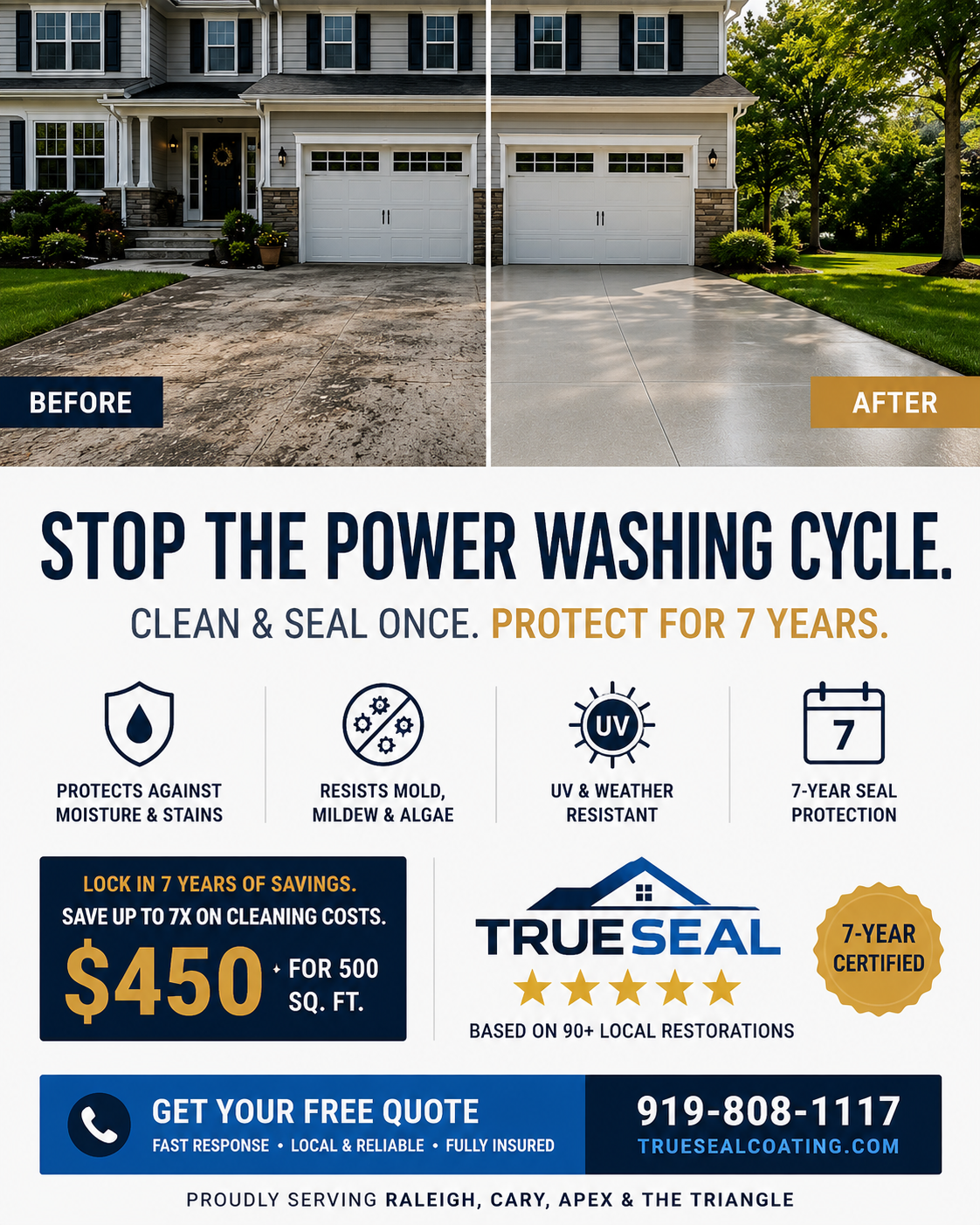
If your loading dock, parking lot, or entry walkway is showing wear, staining, or drainage problems, TrueSeal delivers a complete solution: professional cleaning, targeted repairs, and a commercial-grade sealer matched to your surface and traffic load. We serve Raleigh, Cary, Apex, Garner, and Wake County with a remote assessment process that gets you a written scope fast, without the back-and-forth of a traditional site visit. Request your free quote and protect your concrete before the next season of heavy use.
Sources
The Facility Manager’s guide to concrete floor and surface cleaning | Prosoco
The Complete Facilities Manager Guide to Commercial Concrete | Randahl Construction
Concrete Sealer Pro Playbook: Contractor System Guide – Direct Colors
Commercial Concrete Sealing: Complete Guide for 2026 | Superior Concrete Finishes
FAQ
Does concrete need to be cleaned before sealing?
Yes. Oil, grease, and surface contaminants prevent sealers from bonding correctly. The standard prep sequence is clean, etch, neutralize, and rinse before any coating is applied.
How much does commercial concrete cleaning and sealing cost?
Combined cleaning and sealing services commonly cost a few dollars per square foot, with labor, materials, equipment, and any repairs as the main cost drivers. Request a written quote from TrueSeal for an accurate figure based on your surface size, condition, and sealer type.
How do professionals clean commercial concrete?
Professionals sweep and degrease first, then pressure wash to remove embedded dirt and residue. Service bays and garage floors with oil contamination require targeted degreaser treatment before pressure washing begins.
How often should commercial concrete be resealed?
Penetrating sealers on exterior surfaces typically last 5–10 years. Acrylic topcoats in high-traffic areas may need recoating every 2–3 years. Use the water absorption test annually to catch sealer failure before staining and damage set in.


Comments