Power Wash Driveway Before Sealing in Raleigh? 2026 How-To & Wait Times

Updated: Aug 22
TL;DR
A driveway should always be cleaned before sealing, and power washing is one of the most effective ways to do it. But the surface must dry fully (at least 24 hours, often 24 to 48 hours) before sealer goes on. Asphalt and concrete require different prep approaches: concrete handles pressure washing well, while asphalt needs more controlled cleaning to avoid surface damage. The goal is not maximum pressure. The goal is a clean, dry, bond-ready surface.

Every year, homeowners stare at a faded, stained driveway and think the same thing: clean it, seal it, move on. That instinct is correct. But the details between “clean it” and “seal it” determine whether the finish lasts two years or two months.
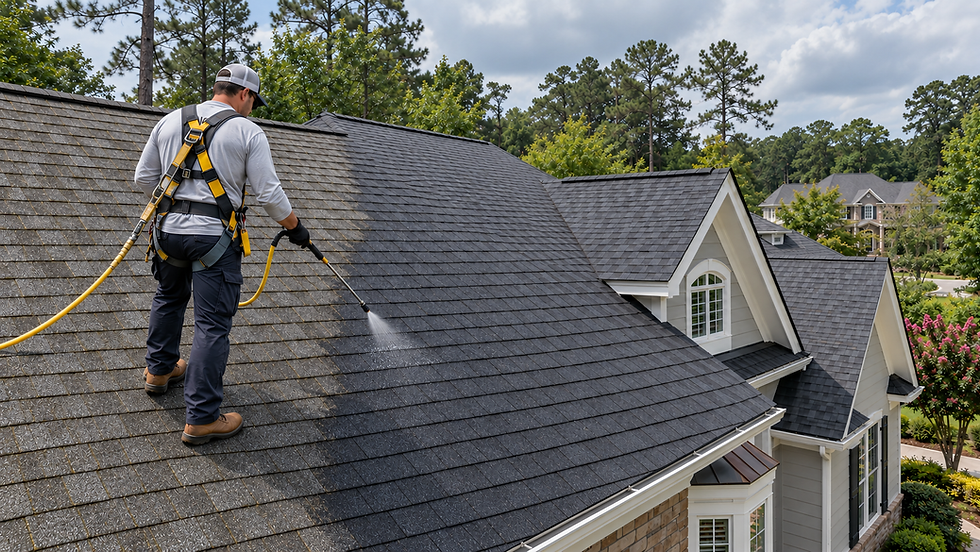
Power washing a driveway before sealing means using pressurized water to remove dirt, pollen, algae, oil residue, and surface contaminants so the sealer can bond to the actual driveway instead of sitting on top of grime. It sounds simple because it is simple. The complications come from doing it wrong, or skipping it entirely.
Get a residential quote if you’d rather have professionals handle the prep and sealing from start to finish.
What “Power Wash Driveway Before Sealing” Actually Means
The phrase gets searched thousands of times, but most people are really asking three questions at once: Do I need to wash first? How long do I wait? Can I damage my driveway?
The short answers: yes, at least 24 hours, and yes if you’re careless.
Power washing before driveway sealing is a prep step. The objective is adhesion. Driveway sealers, whether asphalt sealcoat or concrete sealer, need direct contact with the surface material to bond properly. Anything between the sealer and the driveway acts as a bond breaker. That includes dust, pollen, mildew, algae, oil, grease, loose dirt, tree sap, and even moisture.
Lowe’s states plainly that asphalt sealer will not bond properly if dirt is present. Sika’s concrete sealer instructions say surfaces should be cleaned of dust, dirt, oil, grease, chemical films, coatings, and other contaminants before application.
Worth noting: most homeowners use “power washing” and “pressure washing” interchangeably. Technically, power washing uses heated water while pressure washing does not. For driveway prep, the distinction rarely matters. What matters is the result: a clean surface.
Should You Power Wash a Driveway Before Sealing?
Usually, yes. But the better answer is: you should clean the driveway before sealing, and power washing is often the best tool for the job.
For concrete driveways, pressure washing is almost always the right call. Concrete collects embedded dirt, algae, mildew, and stains that a broom cannot reach. A pressure washer with a 25-degree tip at 8 to 24 inches from the surface handles most concrete cleaning without problems, according to Lowe’s.
For asphalt driveways, the picture is more nuanced. Cleaning is mandatory, but aggressive pressure washing is not always the answer. Practitioners on Reddit’s r/asphalt forum report that many sealcoating pros use brooms, power brooms, and blowers for standard prep, reserving pressure washing for driveways with moss, caked-in dirt, or heavy oil staining. One practitioner explained that pressure washing every job slows production because sealcoat cannot go on wet asphalt, sometimes requiring a second trip.
The principle is straightforward: clean is mandatory, blasting is not.
Asphalt and Concrete Are Not the Same
This is the single biggest gap in most driveway sealing advice online. Articles talk about “driveways” as if asphalt and concrete are interchangeable. They are not, and the prep rules differ in important ways.
Asphalt sealcoat and concrete sealer are completely different products for different substrates. Lowe’s explicitly notes that asphalt sealers are not intended for concrete. Concrete sealers (penetrating silane/siloxane products, film-forming acrylics) work through different chemistry and require a porous, clean, properly cured surface.
Here’s how the prep splits:
On the r/pressurewashing subreddit, a practitioner noted that asphalt does not clean like concrete and that typical asphalt prep involves a backpack blower and rotary brush, with degreaser and pressure washing only for oil-stained areas where adhesion matters. If old asphalt looks gray and oxidized, pressure washing will not restore it. That is what sealcoating does.
TrueSeal Coating provides residential driveway sealing for both asphalt and concrete across the Triangle, tailoring prep methods to each surface type.
How Long After Power Washing Can You Seal a Driveway?
This is the question that trips people up. The surface looks dry, so it must be ready, right?
Not necessarily. A driveway can look surface-dry while pores, cracks, shaded edges, and repaired areas still hold moisture. Sealing over hidden dampness blocks penetration and adhesion, leading to cloudy finishes, bubbling, peeling, and early failure.
The conservative guidance: wait at least 24 hours after power washing before sealing. For concrete, many sources recommend 24 to 48 hours, especially in humid, shaded, or cool conditions. Lowe’s says concrete should dry at least 24 hours before sealant work. A North Carolina pressure washing company recommends 24 to 48 hours for concrete depending on humidity, shade, airflow, and temperature.
For asphalt, the same principle applies. SealMaster’s sealcoating FAQ notes that sealcoat requires 50 degrees Fahrenheit and rising for 24 hours, with no rain imminent within 24 hours. A wet surface from yesterday’s wash creates the same problem as a morning rain.
The “Dry Enough” Checklist
Before applying sealer, confirm all of these:
No standing water anywhere on the surface
No dark damp spots, even in shaded areas
Cracks and joints are dry inside
Edges near grass, flower beds, and downspouts are dry
Forecast shows no rain for at least 24 hours
Surface and air temperatures meet the product label requirements
If you are unsure, wait another day. One extra day of patience costs nothing. A failed seal job costs everything you spent plus removal time.
What Happens If You Seal Over Dirt, Pollen, Oil, or Moisture?
Nothing good. Here is what failing to power wash a driveway before sealing can cause:
Peeling and flaking. The sealer bonds to the dirt layer instead of the driveway. When that dirt layer loosens, the sealer comes off with it.
Cloudy or hazy finish. Moisture trapped under a film-forming sealer creates a whitish, milky appearance that will not correct itself.
Splotchy, uneven color. Dirt patches, pollen film, or oil residue under sealer create visible inconsistencies.
Oil bleed-through. Untreated oil and grease spots migrate through sealcoat, creating dark soft spots that never cure properly.
Recurring failure in the same spots. One Reddit r/asphalt thread about sealer failing repeatedly in specific areas traced the problem to dust and dirt trapped under earlier sealer coats, too many layers, moisture, sap, or failing asphalt binder underneath. More sealer was never the fix. The bond breaker was.
Short service life. Even if the finish looks acceptable initially, poor adhesion means the sealer wears through faster, especially in high-traffic areas and tire-turn zones.
The Complete Driveway Prep Checklist Before Sealing
Power washing is one step in a sequence. Skipping the steps before or after the wash is just as damaging as skipping the wash itself.
Check the product label and forecast. Every sealer has temperature, humidity, and rain-free requirements. Read the label before you schedule.
Move vehicles and protect nearby surfaces. Cover garage doors, walkway edges, and landscaping if needed.
Edge grass and remove weeds. Pull weeds from cracks and trim grass away from driveway edges.
Sweep or blow loose debris. Get leaves, sand, gravel, and loose material off the surface first.
Scrape cracks and remove loose material. Clean out crack debris so filler (if needed) can bond.
Pretreat stains. Oil and grease on asphalt need asphalt-safe degreaser, possibly an oil-spot primer. Concrete oil stains need absorbent material, degreaser, scrubbing, and rinsing. Mildew and algae need appropriate cleaning solution.
Pressure wash or rinse appropriately. Use the right pressure for the surface. Concrete handles more; asphalt needs less.
Let dry fully. 24 hours minimum, 24 to 48 hours in less-than-ideal conditions.
Repair cracks, potholes, or spalled areas. Let repairs cure per product instructions.
Final blow-off. One last pass with a leaf blower removes any dust that settled during drying.
Apply sealer in thin, even coats. Two thin coats dry more evenly and last longer than one thick coat.
This sequence is far more useful than the vague “pressure wash then seal” advice that dominates most articles.
Not sure whether your driveway needs washing, stain treatment, or structural repair first? Submit photos for a quote and get clarity before committing to a plan.
Can Power Washing Damage a Driveway?
Yes. This is a legitimate concern, and it comes up constantly in contractor and homeowner forums.
Concrete Risks
Concrete is harder than asphalt, but it is not indestructible under pressure. Too much PSI, the wrong nozzle, or holding the wand too close can etch lines into the surface. Lowe’s recommends testing a small area and switching to a lower-pressure tip if the water starts etching the concrete.
Practitioners on Reddit warn that high pressure on concrete less than two to three years old is especially risky because the surface cream has not fully hardened. Using chemical treatment for algae and mildew, then rinsing at moderate pressure, often produces better results than brute-force water alone.
The rule for concrete: use enough pressure to remove contaminants, not enough to carve lines.
Asphalt Risks
Asphalt is softer and more vulnerable to pressure damage. A zero-degree tip or aggressive wand passes can scar the surface, strip existing sealcoat, loosen already-weak aggregate, and drive water into cracks right before sealcoating.
In one Reddit thread, users debated whether a contractor “ruined” a sealed asphalt driveway with pressure washing. Comments revealed that sealed asphalt can have its sealant blasted away, though others said high pressure can work on asphalt if done correctly. The takeaway: asphalt requires caution, not avoidance. Many pros rely on blowers, brooms, rotary brushes, spot degreasing, and controlled rinsing unless the surface demands more aggressive cleaning.
Power Washing Is Not Stain Treatment
This distinction gets lost in generic advice. Oil and gas stains need chemical treatment before or during washing. Old flaking sealer may need mechanical removal. Tree sap can cause recurring adhesion failure if not addressed with the right solvent. Pressure alone will not fix these problems, and in some cases will just spread contaminants across a wider area.
Triangle, NC Timing: Pollen, Humidity, and Rain Windows
If you are planning to power wash a driveway before sealing in the Raleigh, Durham, Chapel Hill, Cary, or Apex area, local weather patterns matter more than most national guides acknowledge.
NOAA data for Raleigh-Durham shows 46.07 inches of annual precipitation spread across roughly 118 days per year. Summer months are among the wettest, with July averaging over 5 inches and September averaging 5.15 inches. That is a lot of rain to schedule around.
Spring brings good temperatures but a major Triangle-specific problem: pine pollen. NC State Extension notes that North Carolina pine trees release billions of pollen grains each spring, often peaking around early April. That yellow film on your driveway is a bond breaker. Clean after the heavy pollen drop, not during it.
Summer offers warm curing temperatures, but afternoon thunderstorms can arrive fast, humidity slows drying, and extremely hot pavement can affect sealer application.
Early fall is often the best window. Temperatures are still warm enough for curing, humidity drops, and rain is less frequent before October. Watch for leaf drop and cool, damp mornings.
Winter is generally poor for asphalt sealcoat because product labels require minimum temperatures (typically 50 to 60 degrees) and dry conditions. Concrete sealers have similar, though sometimes slightly wider, temperature ranges.
The best sealing window in the Triangle is not just a warm day. It is a clean, dry surface plus a clear forecast with adequate temperature for the specific product being applied.
When You Should Not Seal Yet
Sealing does not fix structural failure. It protects a surface that is already in serviceable condition. Do not seal if:
Asphalt is crumbling, raveling, or showing alligator cracking
Potholes or trip hazards are still open
Old sealer is flaking off in sheets
Concrete is spalling, scaling, or has an incompatible old sealer
Oil or gas residue remains after cleaning
The surface is still damp or shaded after washing
Rain is in the forecast within 24 hours
Reddit practitioners in r/asphalt regularly push back on the idea that “a bucket of goo fixes everything.” One commenter noted that sealcoat will not meaningfully extend the life of a badly cracked, deteriorated driveway. Cracks need proper crack sealing because water and debris in cracks damage the base underneath. Sealcoat mainly helps with water resistance, UV protection, and curb appeal on asphalt that is still structurally sound.
If sealer keeps flaking in the same spots every time, adding more sealer is not the solution. Find the bond breaker: dirt trapped under earlier coats, moisture, sap, or substrate failure.
A Note on Runoff and Storm Drains
Pressure washing sends sediment, oil residue, cleaners, and old coating particles toward the nearest drain. In many Triangle municipalities, this is a regulated concern. Carrboro’s outdoor washing guidance notes that storm-drain discharges may require approval from the town’s Stormwater Division or NC DEQ, and property owners can face enforcement for illegal disposal.
Keep wash water, sediment, cleaners, and old sealer residue out of storm drains. If you are hiring a contractor, ask how they control runoff, especially on sloped driveways or commercial lots.
For commercial parking lots, TrueSeal Coating provides seal-coating and striping with scheduling designed to minimize disruption during business hours.
When Professional Prep Is Worth It
Some driveways are straightforward: sweep, wash, dry, seal. Others are not. Consider professional prep when:
Asphalt has persistent oil or gas stains that need primer
Moss or algae have colonized shaded areas
Old sealer is peeling and needs removal before recoating
Concrete may have an active old sealer that rejects new product
Cracks, potholes, or spalling need repair before sealing
You want a uniform, deep-black curb appeal finish
You are a property manager who needs documentation and off-hours scheduling
Contractors who emphasize prep (not just the final coat) consistently produce longer-lasting results. LinkedIn posts from sealcoating contractors regularly frame surface prep as the step that determines whether a coating lasts or fails. The finish is visible. The prep underneath is what holds it there.
TrueSeal Coating serves the Triangle with deep power-cleaning prep, commercial-grade sealers, hydrophobic concrete protection, and before/after photo documentation. Check the driveway sealing FAQ for answers about maintenance timing, product longevity, and what to expect.
Frequently Asked Questions
Should I power wash my driveway before sealing it?
Yes. The surface should be clean before sealing. Power washing is especially useful for concrete and heavily dirty driveways. For asphalt, controlled cleaning with brooms, blowers, and spot treatment is sometimes enough, with pressure washing reserved for heavy contamination like moss, algae, or embedded dirt.
How long after power washing can I seal my driveway?
Wait at least 24 hours in good drying conditions (warm, sunny, breezy). For concrete or in humid, shaded, or cool conditions, 24 to 48 hours is safer. If cracks, pores, or shaded edges still look damp, wait longer.
Can I seal a driveway while it is still damp?
No. Damp surfaces prevent adhesion and penetration. Sealing over moisture can cause cloudy, hazy, peeling, or bubbling finishes that fail quickly.
Can pressure washing damage asphalt?
Yes. Aggressive pressure can scar asphalt, strip old sealcoat, loosen weak aggregate, and push water into cracks. Many asphalt pros use blowers, brooms, and spot treatment first, only pressure washing areas with heavy contamination.
Can pressure washing damage concrete?
Yes. Too much pressure, the wrong nozzle, or holding the wand too close can etch the surface and leave visible lines. Start with moderate pressure, test a small area, and keep the wand moving.
What if my driveway has oil stains?
Treat oil and grease before sealing. Asphalt may need an asphalt-safe degreaser and oil-spot primer. Concrete may need absorbent material, degreaser, scrubbing, and thorough rinsing. Power washing alone will not remove deep oil contamination.
Should I seal a brand new driveway right after pressure washing?
Not automatically. New asphalt typically needs 30 to 60 days of cure time (some products require 6 months including a full summer). New concrete usually needs about 28 to 30 days of curing before most sealers. Check installer guidance and product labels.
Is spring a good time to seal a driveway in North Carolina?
It can be, but wait until after the heavy pine pollen drop (often peaking around early April) and avoid wet weather. The surface must be clean and dry, and temperatures need to meet the sealer’s requirements for at least 24 hours before and after application.
Contact TrueSeal Coating for a residential driveway assessment in Raleigh, Durham, Chapel Hill, Cary, Apex, or anywhere in the Triangle.


Comments